ARKEO ARSLAN

Arslan Gallery
 Bird’s-Eye View of ArslantepeGenerated by artificial intelligence (AI). |  King of Melid (?)Our own photograph. In some sources, the figure is referred to as Mutallu, while in others it appears as Tarhunazi. It is believed to originate from the Kingdom of Melid or from the Late Hittite Period. |  Lion GateOur own photograph. |  Stone Relief City Wall“Arslantepe, Iron Age (Phase III). a.b. Stone reliefs and the city wall from Iron Age I (Frangipane, 2018).” |
|---|---|---|---|
 PalaceB Temple and Palace Complex (Frangipane, 2004b, p. 48) Archaeological research shows that the public buildings in this area evolved over time into an integrated compound composed of three units serving religious, economic, and administrative functions. Distinguished by its scale and layout, the complex represents one of the earliest examples of a temple–palace architectural ensemble (Frangipane, 2002). |  Palace(Exterior)Arslantepe Mound Palace Architecture Source: Frangipane, M. (2011) |  Palace(Exterior)Arkeoatlas: Archaeology Atlas of Anatolia from Prehistory to the Iron Age, (Ed. N. Karul), Eastern Anatolia, p. 137. |  Palace(Interior)Our own photograph. |
 Wall PicturesPeriod VIA (LC5). a. Temple B in the Palace; b. Decoration on the walls of the side room in Temple B (Frangipane, 2018). |  SwordsIn Building III of the palace, nine arsenic–copper alloy swords and twelve spearheads were discovered, some decorated with silver inlay. At the monumental entrance of another structure, a door pivot made of arsenic–copper alloy with lead and 19 silver, along with other advanced alloy findings, indicates that metallurgy had reached a high technological level and that swords were produced here for the first time in history. (Frangipane, 2018) Our own photograph. |  Storage Area and PotteryArslantepe, Period VIA Palace Storage Rooms. a. Reconstruction of the original positions of materials within the rooms (drawing by T. D'Este); b. Cretula from redistribution room A340; c. Mass-produced bowls from redistribution room A340; d. Storage rooms (Frangipane, 2018). |  CeramicsArslantepe, Period VIA. Ceramics found in the palace complex (a–d) (Frangipane, 2018). |
 Seals and Seal Impressions(Frangipane 2018) | 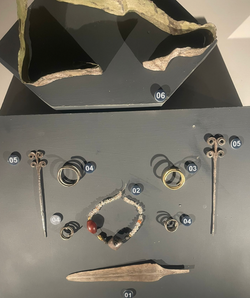 JewelryOur own photograph. |  Excavation WorkFig 1.(Frangipane, 2018) |  Arslantepe House (Exterior)Our own photograph. |
 Arslantepe House (Interior)Our own photograph. |  BurialsArslantepe, Late Period VIB1: The so-called “Royal Tomb” (Frangipane, 2018) |  Visitor CenterOur own photograph |
Click on the image.
History
This section of our website describes the history of Arsantepe Mound. The following sections were created using the resources in the bibliography.
1. The First Settlement and Village Order (6000–4000 BC)
In Arslantepe's earliest periods, the region consisted of modest villages inhabited by small family communities. Houses were mostly made of adobe (brick made from a mixture of soil and straw), single-roomed, and functional. People subsisted on agriculture, animal husbandry, and basic handicrafts, and the community structure was egalitarian. During this period, there was no political authority or administrative center; order operated through traditional community rules and a simple division of labor. However, the mound gradually began to grow, and the region began to realize the potential for a larger center in the future.
2. The Emergence of Temple-Centered Society (4000–3500 BCE)
During this phase, Arslantepe ceases to be an ordinary village and becomes a regional ceremonial and community center. Large temple structures appear on the hilltop, highlighted by spacious courtyards, ceremonial rooms, and colorful wall decorations.
The economic affairs of society—the gathering, storage, and distribution of goods—become increasingly controlled by temple officials. This creates the first distinct elite. The governing structure of society is now entirely religious, with authority reinforced by sacred traditions.
The architecture around the temple shows the first signs of its development into a more monumental and influential centre on a regional scale.
3. Strengthening of the Administrative Order and Bureaucratic Structure (3500–3300 BC)
This is the critical period when Arslantepe takes its first steps toward institutional identity. No longer a place solely for religious ceremonies, the site features organized warehouses, sealed doors, record-keeping staff, and mass-produced containers.
The administration establishes more systematic control over the community.
Large halls, corridor plans, warehouses and administrative rooms begin to appear in architecture.
This table shows that the first example of a proto-state (the first form of administration and bureaucracy without an official state) emerged in Arslantepe.
Society was now organized both religiously and administratively, and had a more complex structure.

4. The Emergence of Palace-Centered Government (3300–3000 BC)
During this period, Arslantepe became one of the independent political centers of the Near East. The temples declined in power, and a large administrative complex—a kind of early palace—emerged in their place.
This palace focuses on administrative functions rather than ceremonial ones. Inside, it houses grain silos, executive offices, meeting areas, and sections for product inspection.
The social distance between the people and the elite becomes more pronounced. The ruling class now establishes its authority through administrative power and economic control, as well as religious legitimacy.
This period is Arslantepe's brightest political phase: centralized power, organized economy and regular institutions.
5. Collapse, Reconstruction, and the Walled City (3000–2500 BC)
The palace system ended with a devastating fire. Following this rupture, Arslantepe was reorganized, but administrative power on the same scale as the old palace did not return.
In the new period, the settlement shrinks, but the city walls strengthen. Arslantepe no longer becomes a regional settlement but a more limited urban fabric focused on defense.
Architecture becomes simpler and more functional; houses and small community spaces for public life replace large ceremonial or administrative buildings.
This period is a transition period in which the central power weakened but the settlement was not completely abandoned.
6. The Late Hittite Melid Kingdom and the Last Period (1200–600 BC)
Arslantepe regained its importance during this phase, becoming the political center of the Melid Kingdom. The city experienced a revival; monumental entrances made of stone blocks, lion statues at the city gates, and palace-like structures characterized this period.
Political authority has now risen to the level of a regional kingdom.
This period is also the “last great stage” of Arslantepe in history.
It lost its importance from the 7th century BC onwards; although settlement continued until the Roman and Byzantine periods, its former splendor was not seen.

General Evaluation: The Great Story of Arslantepe
The long history of Arslantepe reveals both traditional and innovative steps of Near Eastern political organization on the same stage.
The process from a village to a temple, from a temple to a bureaucracy, from a palace to a walled city and finally to a royal center has shaped the social, economic and political fabric of the region for centuries.
This evolutionary line makes Arslantepe a unique laboratory on the Anatolia-Mesopotamia axis.
Comparative Comment
The history of Arslantepe resembles the process of a community's growth and establishment of order: Initially, small, egalitarian villages were simple and functional, like a startup. During the temple period, identity and rituals were formed, establishing a cultural structure. While operations were standardized through bureaucracy, recording and control systems operated like a medium-sized company. During the palace period, power became centralized, and strategy and resource management became prominent. The walled city experienced a post-crisis downsizing, with defense and functionality taking precedence. In the Melid Kingdom, a broad administration with regional influence emerged. In short, Arslantepe is a reflection of the thousands of years of human communities' value-producing and organizing processes.
Values Commentary
Arslantepe's line demonstrates the evolution of social values from village equality to institutional authority and then to political legitimacy. Initially, community solidarity and production were central values; then, in the temple period, sanctity, order and accountability in the bureaucracy, power and centralization in the palace period, and continuity and security at the state level in the Hittite period came to the fore. Each period optimized its own set of values, feeding the next.
Frequently Asked Questions

World Heritage
ARSLANTEPE & UNESCO
Arslantepe Mound, located in the Malatya plain, is one of the principal reference points of Near Eastern archaeology, distinguished by its uninterrupted occupation from the 6th millennium BCE to the Middle Ages. The monumental mudbrick palace complex dated to the Late Chalcolithic period, together with seal impressions documenting hierarchical governance, the emergence of central authority, and early bureaucratic practices, provides some of the earliest archaeological evidence for state formation. Following Turkey’s inclusion of the site on the UNESCO Tentative List in 2014, conservation–management initiatives, comprehensive scientific reports, and ICOMOS technical evaluations affirmed Arslantepe’s “outstanding universal value” at the international level. As a result of these assessments, the site was inscribed on the UNESCO World Heritage List during the 44th Session of the World Heritage Committee in 2021, due to its unique contribution to the archaeological representation of early statehood. Today, Arslantepe serves as a key reference point in studies of Anatolian and Near Eastern cultural history, offering exemplary material for reconstructing early political organization through its material culture.

Arslantepe and the Importance of Preserving Cultural Heritage
Cultural heritage represents our most valuable collective memory, carrying the knowledge, beliefs, and lifeways of past civilizations into the present. One of the greatest threats to this heritage is vandalism—acts such as damaging historical structures, unauthorized excavations, graffiti, scratching, or any uninformed intervention—which can irreversibly destroy cultural assets. Combating vandalism therefore requires awareness-raising, protective measures, and the active participation of society. With its millennia-long history, Arslantepe Mound stands as one of humanity’s most significant heritage sites, preserving early evidence of state formation and exceptional archaeological findings. Yet the strength of Arslantepe lies not only in its scientific importance, but also in the deep sense of attachment expressed by the local community. The stewardship, support, and conscious engagement of the people living in the region play a decisive role in safeguarding the site and ensuring its preservation.
Protecting Arslantepe—and all cultural heritage—is a shared responsibility. It is through this collective commitment that we can carry the past into the future and uphold the common values of humanity.